Picking goal management software is a category problem before it's a brand problem.
Most teams jump straight to comparing platforms, when the real question is whether they need a dedicated tool, an HR suite, or a goals module bolted onto their work management platform. Get the category wrong and no brand inside it will fit.
So this guide goes in that order. First, the three categories and how to tell which one you need. Then 18 tools worth considering, with a clear "best for" and "not for" on each. Then four questions that narrow your shortlist faster than any feature checklist.
Fair warning: we make Tability, so we're not pretending to be neutral. What we can do is be specific about where each tool wins and where it doesn't, including ours.
If you're already committed to OKRs specifically, our OKR software guide is the more focused read. This one is for anyone setting and tracking goals, OKR or otherwise.
TL;DR: just tell me what to get
- For team and company goals, Tability ranks first, with Perdoo the best structured alternative.
- For employee goals tied to performance reviews, pick an HR suite: Lattice or 15Five for most companies, Profit.co if you want team goals and reviews in one contract.
- If your team already lives in Asana, ClickUp or Jira, try their built-in goals before buying anything. For free, Teamflect covers 10 users with everything included.
Who this guide is for
This is for teams and companies that want to set goals, track them weekly and see across the organisation what's on track and what isn't. That covers OKRs, KPIs, SMART goals or your own format.
It isn't for personal goal tracking. If you want an app for your own habits or New Year resolutions, a personal goal tracker will serve you better than anything below.
It also isn't for teams under 10 people who are still working out their goal process. A spreadsheet template is enough at that stage. Rolling out a platform before the habit exists tends to kill the habit.
What is a goal management software?
A goal management software is a tool that centralises how a team or company sets, tracks, and updates progress against measurable goals. It replaces the spreadsheet mess most companies start with, and gives leaders visibility into what's on track, what's at risk, and what's drifted.
A good goal management tool does four things well:
- Captures goals in one place, with clear owners, metrics, targets, and deadlines.
- Makes progress visible through dashboards, status indicators, and weekly check-ins.
- Surfaces problems early with at-risk flags, stale-update alerts, and AI-driven anomaly detection.
- Connects to AI agents and assistants through MCP servers, native AI modes, or autonomous goal agents that can read from and write to your goal data.
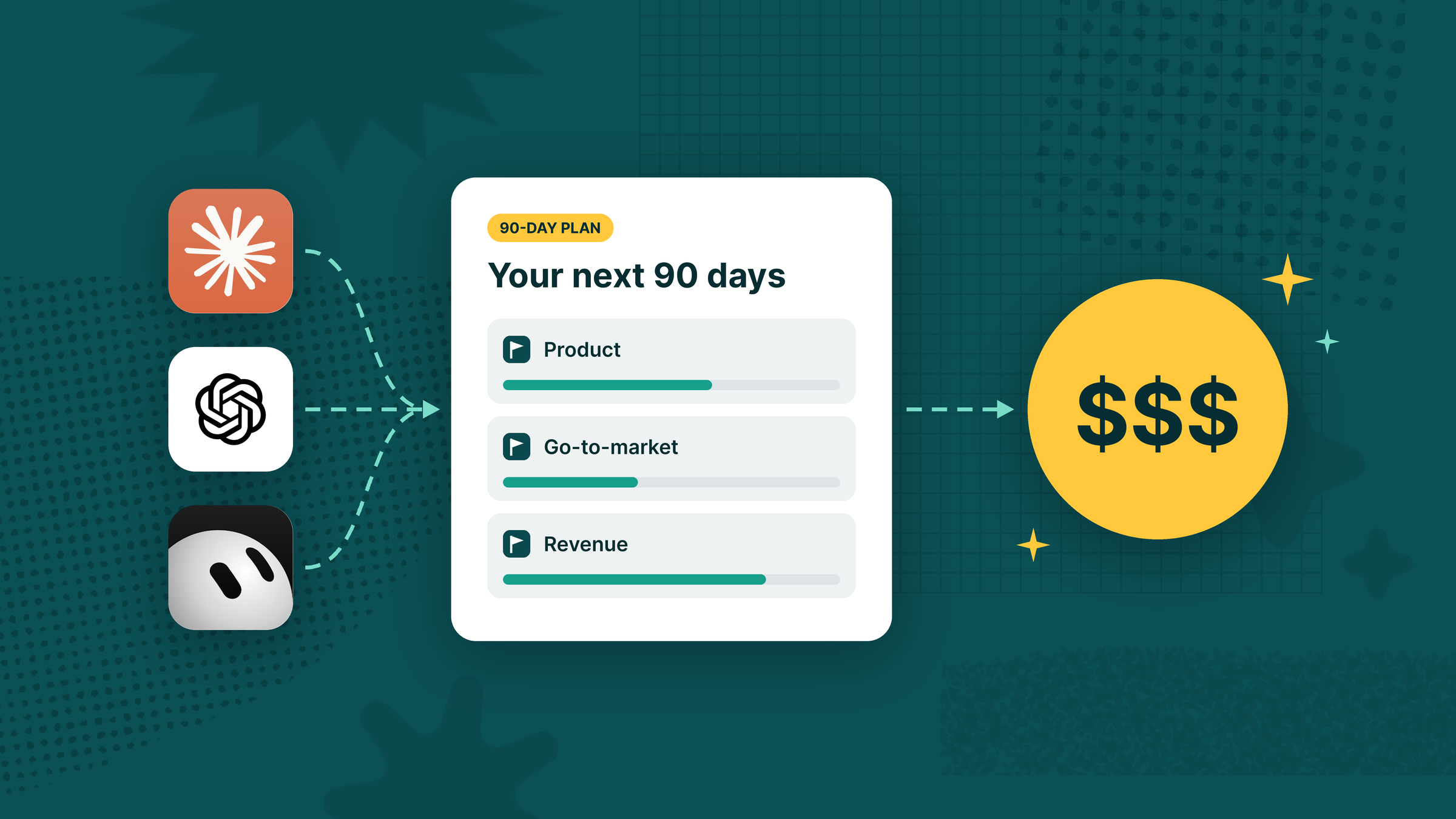
That last one is new, and it's quickly becoming the dimension that separates modern goal tools from legacy ones. In 2026, your goal data shouldn't just sit in a dashboard nobody opens. It should be queryable from Claude or ChatGPT, surfaceable inside your check-in conversations, and updatable by agents working on the goal alongside humans.
One last thing: the best tool in the world won't save a team that doesn't actually talk about its goals every week. Software makes the habit easier. It doesn't manufacture it.
3 types of goal management software (pick the right one first)
Before you start comparing brands, decide which category you need. Most teams skip this step and end up paying for features they don't use.
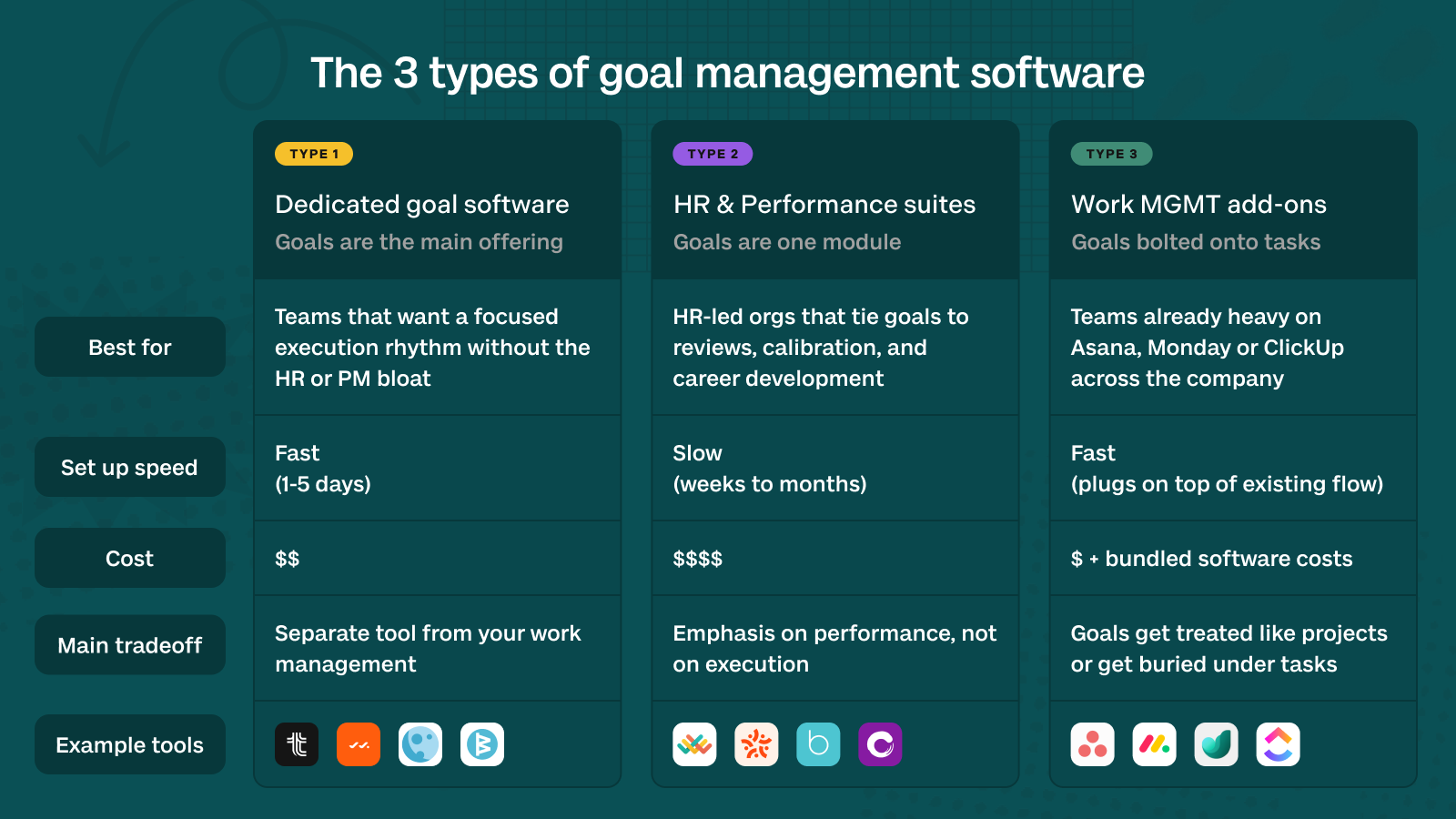
1. Dedicated goal setting tools. Built for setting and tracking goals or OKRs. Goals are the product rather than a tab inside something else, so they're usually the fastest to roll out and the strongest on check-ins and reporting.
2. HR and performance management suites. Goals are one module next to reviews, 1:1s, engagement surveys and compensation. They suit HR-led organisations that want individual goals tied to performance conversations. Setup is heavier and the goals module moves slower, because goals aren't where the roadmap goes.
3. Project tools with a goals module. Work management platforms that added a goals layer. Often the cheapest option because you already pay for the project tool, but goals tend to get treated as one more project.
The trade-off in one line each:
- Dedicated tools are fastest to adopt but sit next to your project tool rather than inside it.
- HR suites connect goals to reviews but are overkill for business and team goals.
- Project tool add-ons are cheapest but bury goals under tasks.
Employee goal setting software vs team goal software
This is the question that splits the market, and most buyers only notice it after they've signed.
Employee goal setting software is about individuals: what someone is working on, how they're developing and how that feeds their review and compensation. The goal is part of a development conversation and lives next to 1:1s, feedback and calibration.
Team goal software is about outcomes: what the business is trying to achieve this quarter, who owns it and whether it's on track. The goal is part of an execution rhythm and lives next to strategy reviews and weekly check-ins.
Trying to do both in one tool usually goes wrong in a predictable way. Put team goals in a review system and people sandbag their targets so they look good at calibration. Put reviews in a goal tool and HR goes without the calibration and comp workflows it needs. Our take on performance goals vs OKRs covers why most companies should keep them in separate systems.
There's one overlap worth checking whatever you pick: managers need to see a person's goals before a 1:1. Of the ten platforms where I checked, only Tability, Perdoo and Weekdone showed one person's goals in a single view.
How I evaluated these tools
Wherever I could get access, I tested the product myself. I signed up, created the same quarterly plan for a sales team and timed how long it took to get to a working setup.
Some tools did not make that possible. Several HR suites and enterprise platforms only open up after a sales call, and a few are priced in a way that makes a trial meaningless. For those, I relied on product documentation, public pricing and user reviews, and I've kept the verdicts to what those sources support.
What to look for in goal setting software
Core goal features are table stakes now. Every serious tool has goals, owners, check-ins and a progress bar. What separates them is how they're implemented. Six things to test in a demo, with the question that exposes each one in under a minute.
Setup that doesn't need a form per goal
- Look for: an importer that takes a spreadsheet or pasted text and builds the plan, with start values and units detected.
- Ask in the demo: "Here's our plan as text. Get it into the product." Time it, then multiply by your number of teams.
A check-in people will actually do every week
- Look for: a check-in that takes under a minute, lets the owner set the status themselves and keeps the comment attached to the number. A goal nobody updates is worse than no goal, because it looks like information.
- Ask in the demo: "Post an update with a comment, then show me how someone replies to it."
Reporting that exists before you build it
- Look for: the plan itself as a dashboard, a presentation mode for leadership and a per-person view for managers.
- Ask in the demo: "The leadership meeting is tomorrow. What do I put on the screen?" Then: "Pull up one of my direct reports."
Goals that update from your data
- Look for: data connectors that update a goal from Salesforce, HubSpot, a warehouse or a Jira query on a schedule. Around half the platforms I tested could do this. The rest update by hand.
- Ask in the demo: "Connect this goal to a live number. How often does it refresh?"
AI that reads your goals, not just the help centre
- Look for: an AI mode that answers "which goals need attention" from your own workspace, and an MCP server so Claude or ChatGPT can query the same data.
- Ask in the demo: create a goal, then ask the product's AI to summarise it. On most of the platforms I tested, it either couldn't run or got it wrong.
Control over who creates goals
- Look for: SSO and SCIM as a baseline, then control over who can create goals and edit each plan.
- Ask in the demo: "Can you show me how to stop people from adding extra goals?" Very few can.
All 18 tools at a glance
Prices checked against vendor pages between 15 and 28 September 2026, billed annually unless noted. Weekdone's pricing page was erroring, so that figure is unconfirmed. For costs at 25, 100, 500 or 2,000 seats, see cost by company size.
Best goal setting software for team and company goals
These are the dedicated tools, built for outcomes a team or company is working towards rather than individual performance.
1. Tability
Full benchmark profile · tability.io
Best for: mid-market and enterprise teams that want team goals, OKRs and KPIs running quickly, with dashboards and AI built in.
Not for: HR-led rollouts where goals feed performance reviews and compensation.
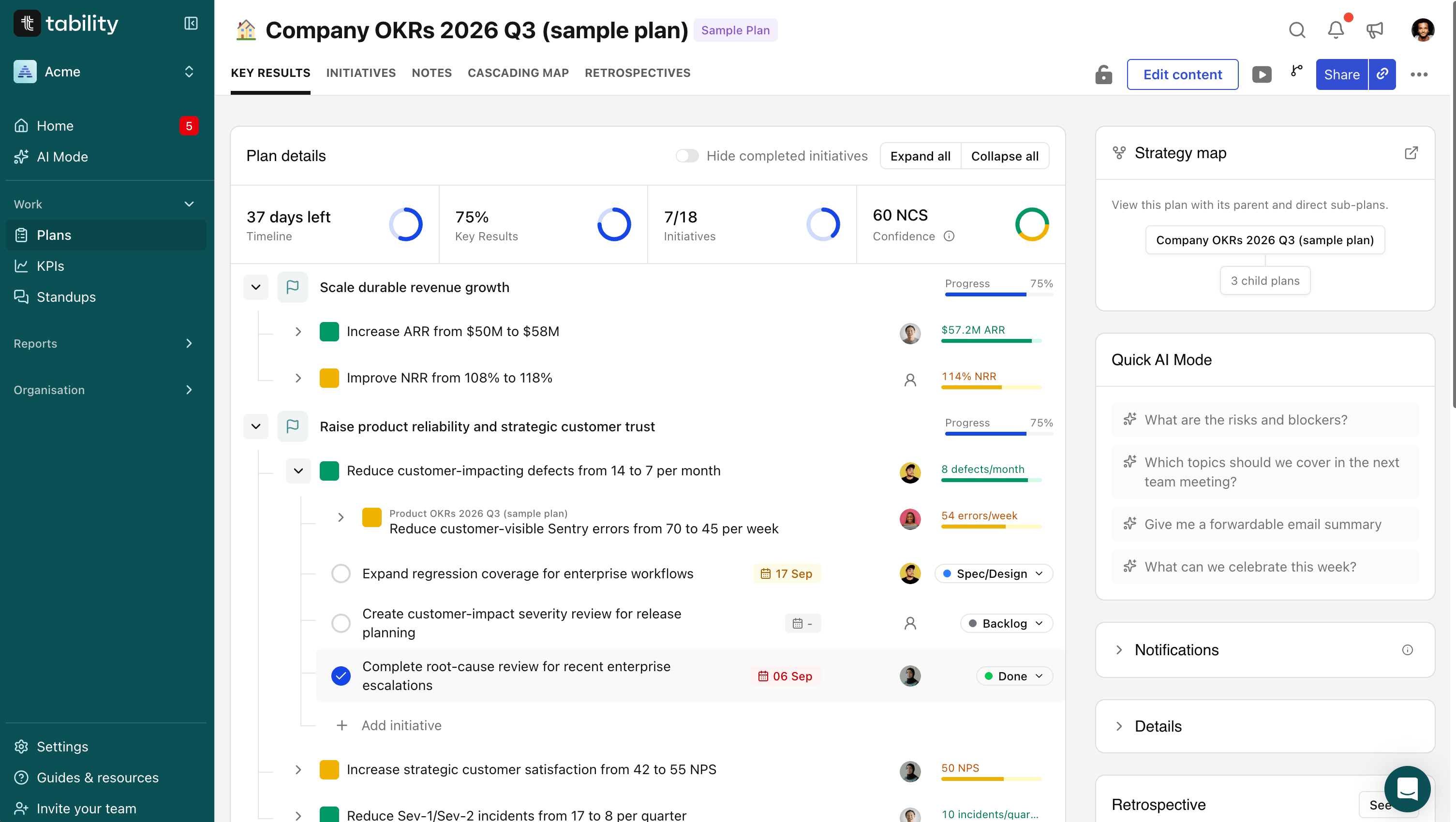
Tability is built on the idea that goals fail when nobody checks in on them, and rollouts fail when the tool is too heavy. Every goal has one owner who posts a short weekly update, and the plan itself is the dashboard, so there's nothing to assemble before the first leadership review. It was also the only tool where I could import several team plans from one spreadsheet.
Strengths
- The plan is the dashboard: presentation mode, strategy map and a per-person view come without building anything.
- Goals that fit the metric: start-to-target, stay above or below a threshold, milestones, rollups, plus a separate KPI module.
- AI across the product: MCP server for Claude and ChatGPT, an in-app AI mode that reads your workspace, and scheduled prompts that write a recurring business review from live data.
- Data connectors to Salesforce, HubSpot, Amplitude, Power BI, BigQuery and Jira, refreshed daily or weekly.
- Governance for a rollout: restricted plan creation, per-plan permissions, SAML SSO, SCIM, audit history, hosting in the EU, Australia and the US.
Where it falls short
- No free plan.
- No performance reviews and limited HRIS integrations, so if goals feed reviews you'll pair it with an HR platform.
- Customisation is limited on purpose. You won't get hundreds of custom fields.
Pricing: $6/user/month Basic, $10 Premium (annual), with two free read-only seats per Premium seat. Enterprise custom. 14-day trial.
2. Perdoo
Full benchmark profile · perdoo.com
Best for: teams that want a structured cascade from company goals down to teams, with KPIs alongside.
Not for: teams that need leadership dashboards out of the box or fine-grained permissions.
Perdoo had one of the fastest setups I tested: its text importer parsed the whole scenario in one go. It's also one of three tools with a proper per-person dashboard, which matters if managers use goals in 1:1s. Where it left me wanting was leadership reporting. The dashboards are yours to build and there's no presentation mode I could find.
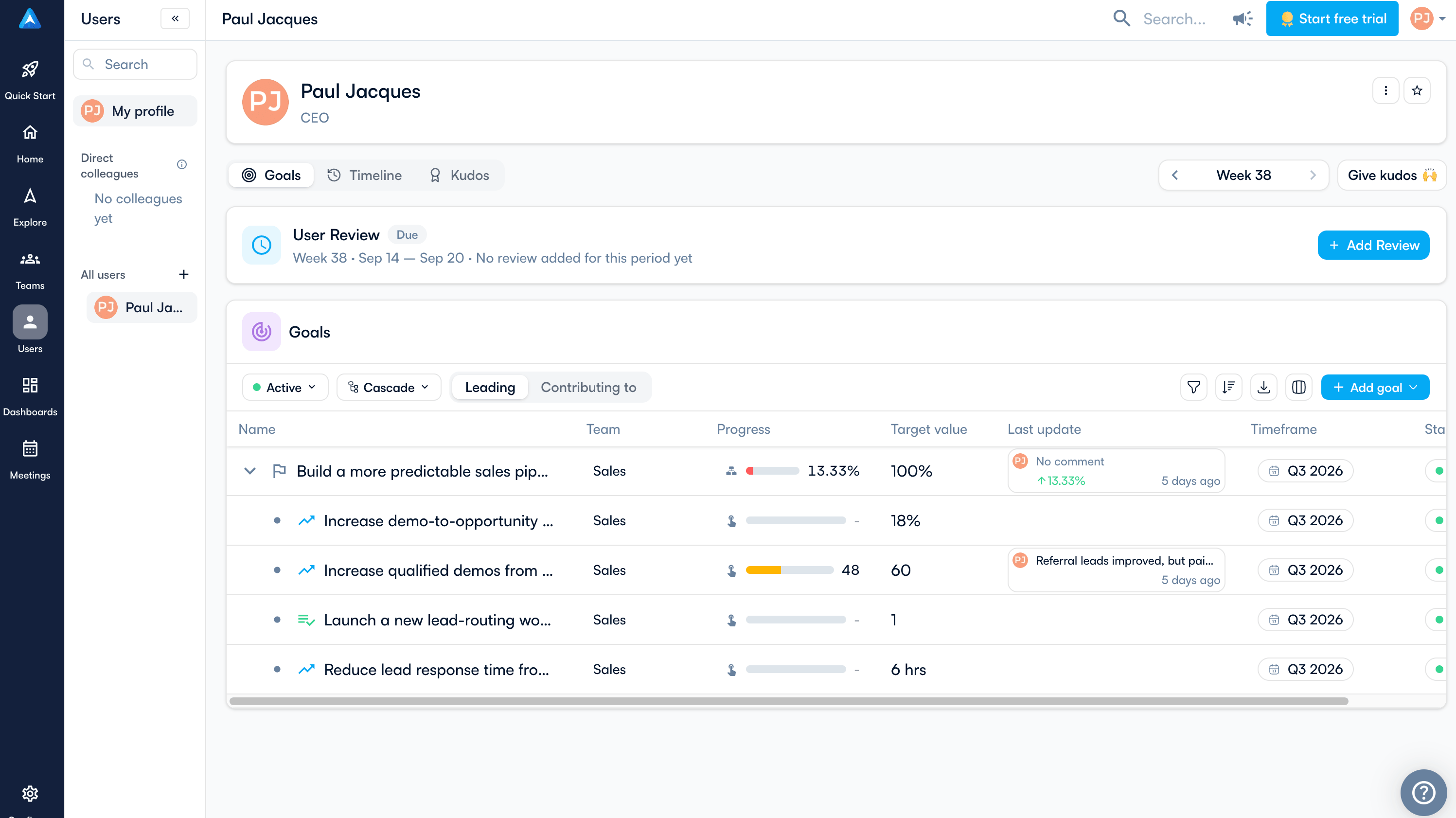
Strengths: fast import, per-person dashboards, a useful warning when a goal is really a task, an MCP server, and connectors into HRIS tools like BambooHR and Factorial.
Where it falls short: in-app AI stops at the importer, few dashboards by default, no control over who creates goals, no monthly billing.
Pricing: free to 5 users. Premium $9/user/month, Supreme $11, annual or quarterly only.
3. Mooncamp
Full benchmark profile · mooncamp.com
Best for: clean, manual goal tracking for a team that likes Notion-style tools.
Not for: anyone who needs AI, an importer or ready-made leadership reporting.
Mooncamp is one of the easiest tools here to pick up. The core goal workflow is solid, with proper start and target values, weighted rollups and custom goal types, and it's EU-based. What I couldn't find was anything a rollout needs after the first team: no importer, no public API, no AI, and dashboards you build by hand.
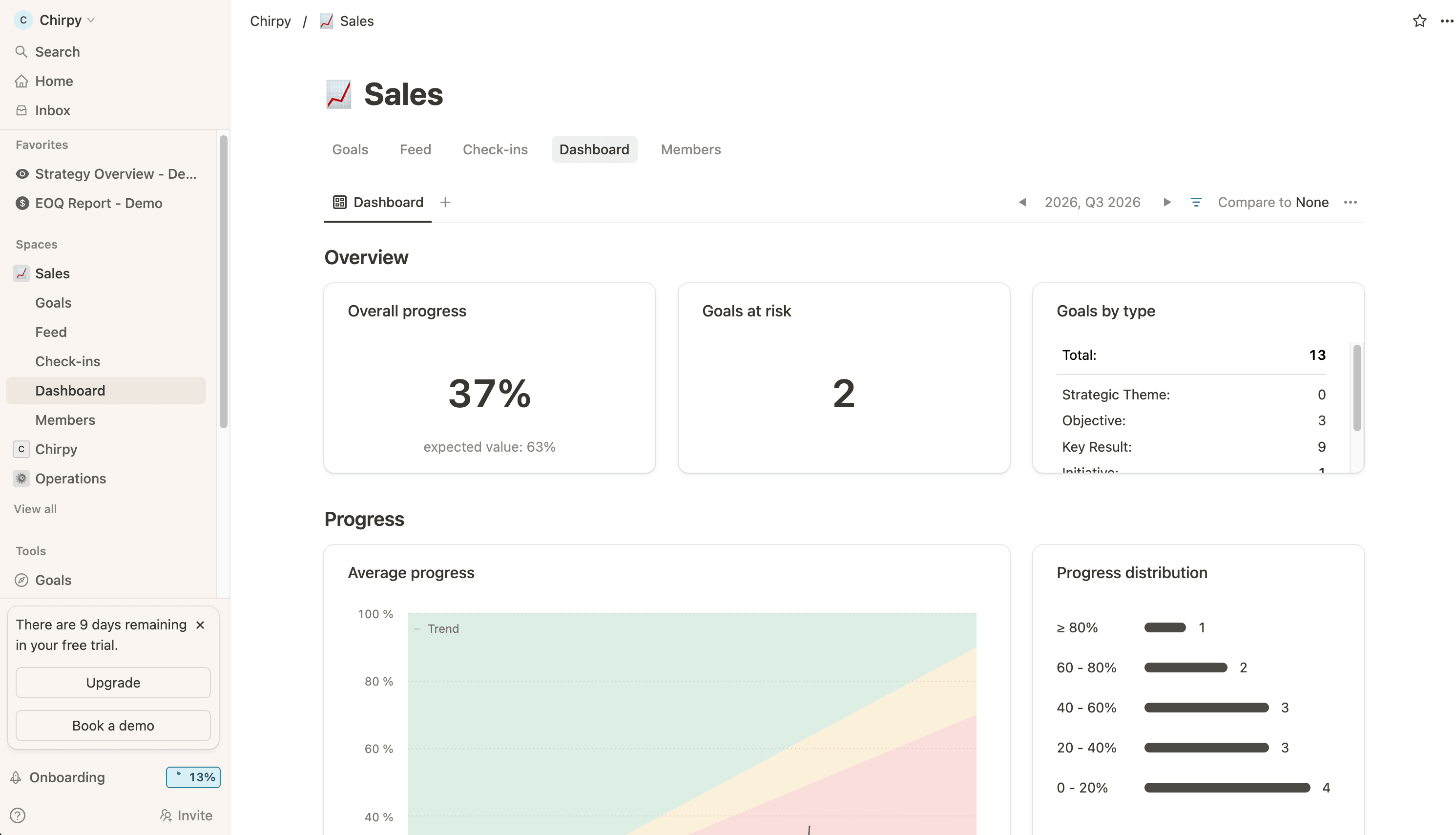
Pricing: Essential €7, Professional €10 per user per month, annual only. No free plan.
4. Workboard
Benchmark profile · workboard.com
Best for: very large, services-led rollouts with a change-management partner attached.
Not for: teams that want to try before a sales call, or roll out without paying for onboarding services.
Workboard is an enterprise strategy execution platform with strong business review tooling and AI briefings, and it absorbed Quantive in 2025. It's sold through demos and services. Two questions worth asking in that demo: show me the check-in, and can I query my goals from Claude or ChatGPT.
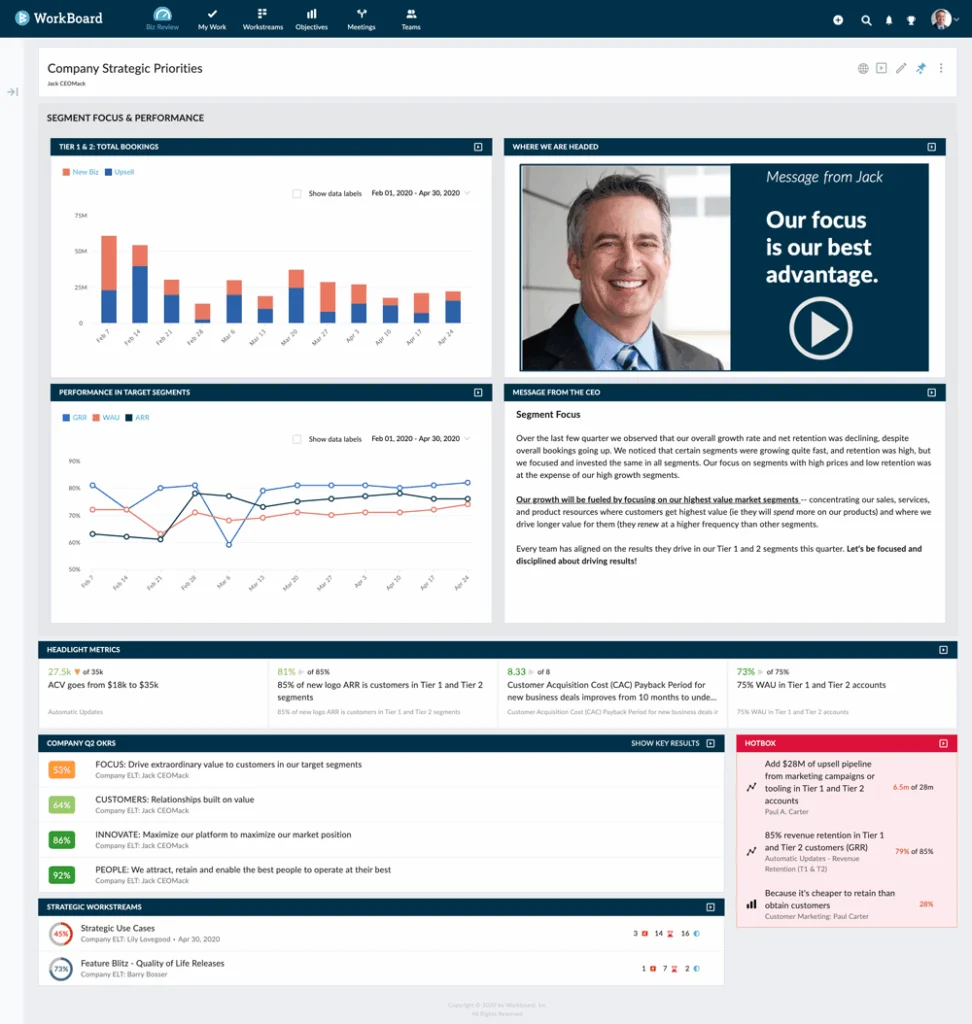
Pricing: quote-only. Deployed cost with services runs well above everything else here.
5. OKRs Tool
Full benchmark profile · okrstool.com
Best for: a small team on a tight budget that can live with rough edges.
Not for: a company-wide rollout, or anyone who needs goals to update from their data.
OKRs Tool charges a flat monthly fee rather than per seat and ships a lot for the price: an AI drafter, an MCP server and more pre-made reports than anything I tested. It needs another year. The import set every starting value to zero, several reports never loaded, and there are no data connectors.
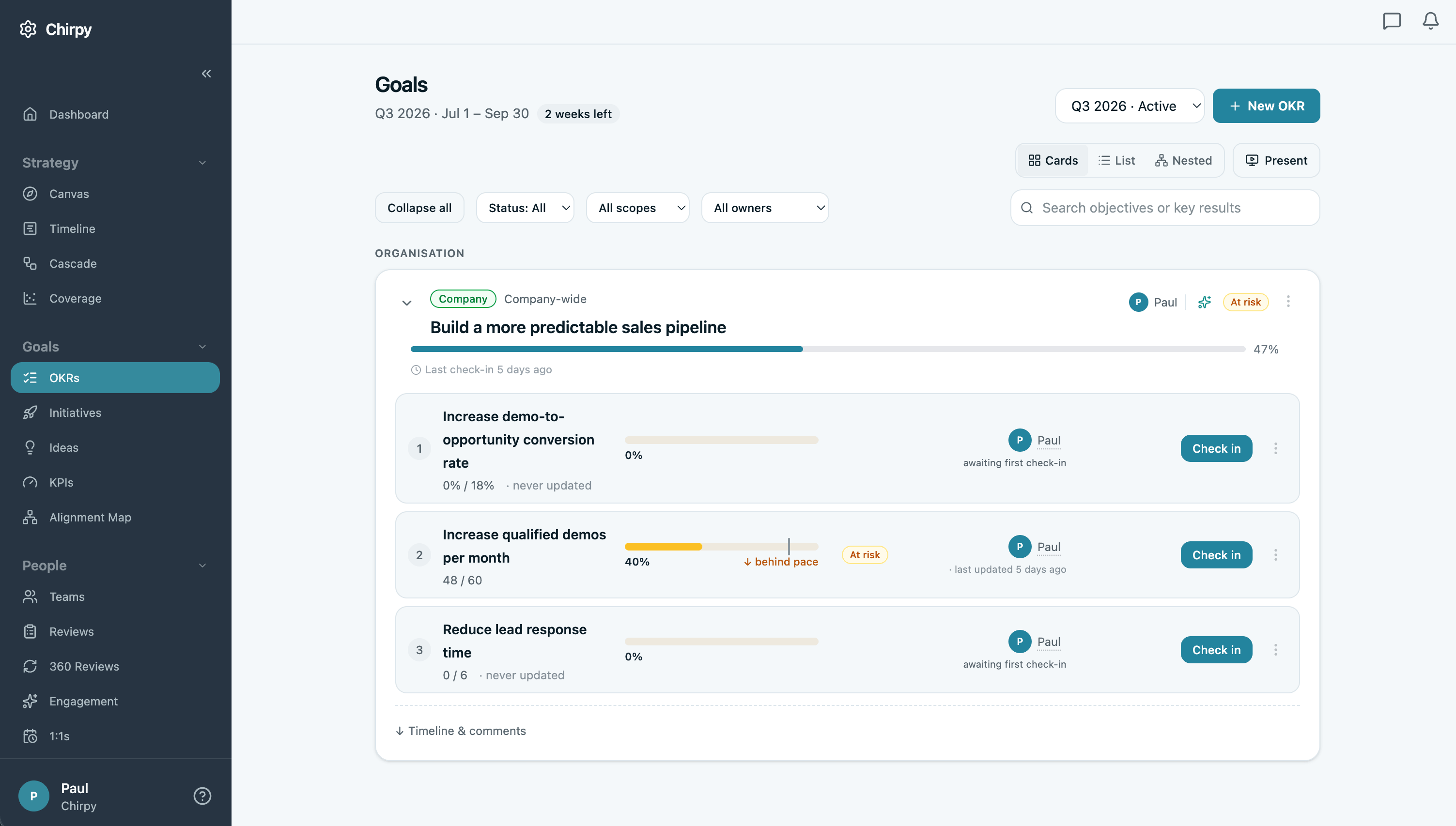
Pricing: $49 a month flat up to 50 users, $129 above that. Free for 1–5 users.
6. Weekdone
Full benchmark profile · weekdone.com
Best for: very small teams learning goal setting on the free tier.
Not for: anyone who wants owner-set status, trend charts, AI or connectors.
Weekdone is one of the older tools in the market and pairs quarterly goals with weekly plans. The tree view is the clearest read of goal structure I saw, and it's one of two tools that let an admin restrict who creates goals. The check-in dates it: the product decides your status from progress, with no override.
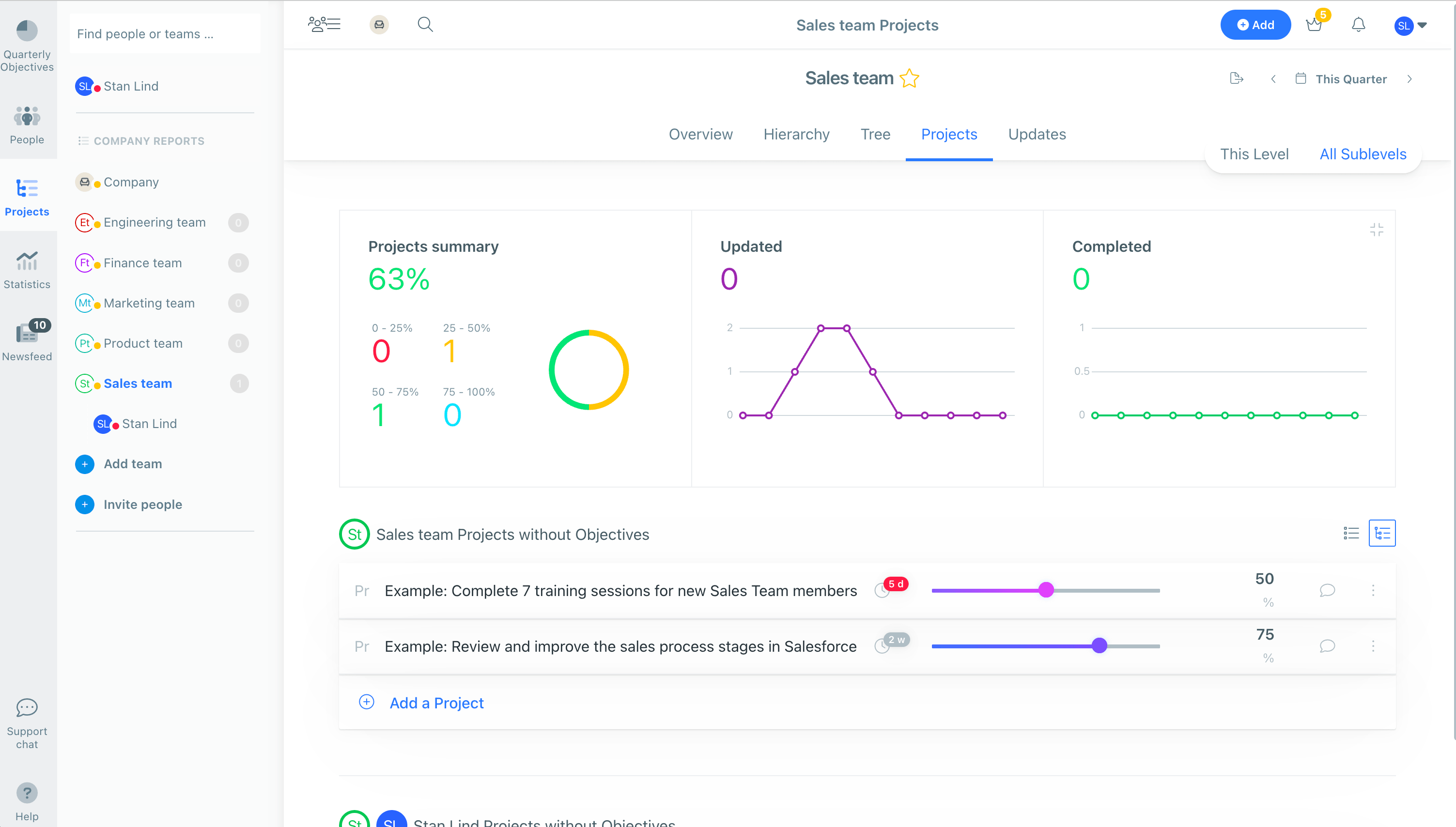
Pricing: free for 3 users, then around $9/user/month (unconfirmed).
Best employee goal setting software
These are HR and performance suites where goals sit next to reviews, 1:1s and feedback. Pick from this group if HR owns your goal process and individual goals need to feed performance conversations.
1. Lattice
Compare Lattice to other platforms · lattice.com
Best for: companies of 200+ that want goals, reviews, 1:1s and engagement in one HR platform.
Not for: teams that only need goal tracking.
Lattice is the default shortlist entry for employee goal setting software. Goals and OKRs are sold as their own module, and goal progress sits next to review history, 1:1 notes and weekly updates, which is useful for HR teams running formal cycles. The downside is that goals get pulled toward the review conversation, which is where sandbagging starts.
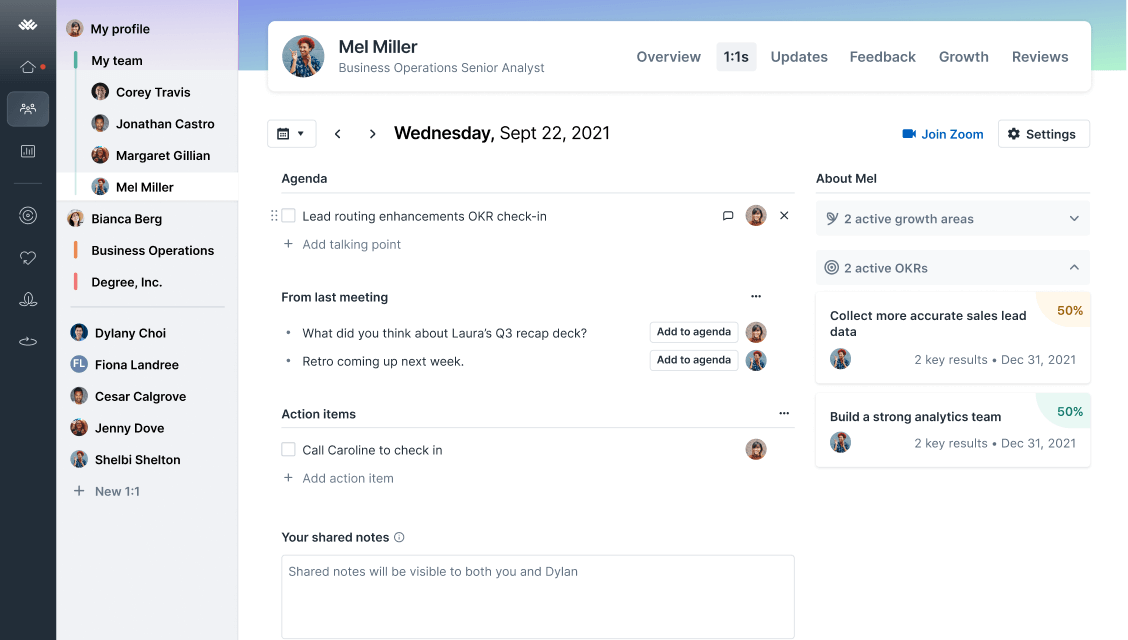
Pricing: Goals & OKRs $8/seat/month, Performance $10, or the Foundations package at $13. $4,000 annual minimum, billed annually.
2. Profit.co
Full benchmark profile · profit.co
Best for: companies that want team goals, performance management and tasks in one contract, and have an admin to configure it.
Not for: teams that want something usable without training, or a published price.
If you want employee goals and team goals in the same tool, Profit.co is the most complete option I tested. The enterprise controls and its 21-connector catalogue go further than anything else in the test. The cost is setup time: every goal is a KPI you define first, the interface is busy, and I came away thinking of it as an advanced spreadsheet with a serious back end.
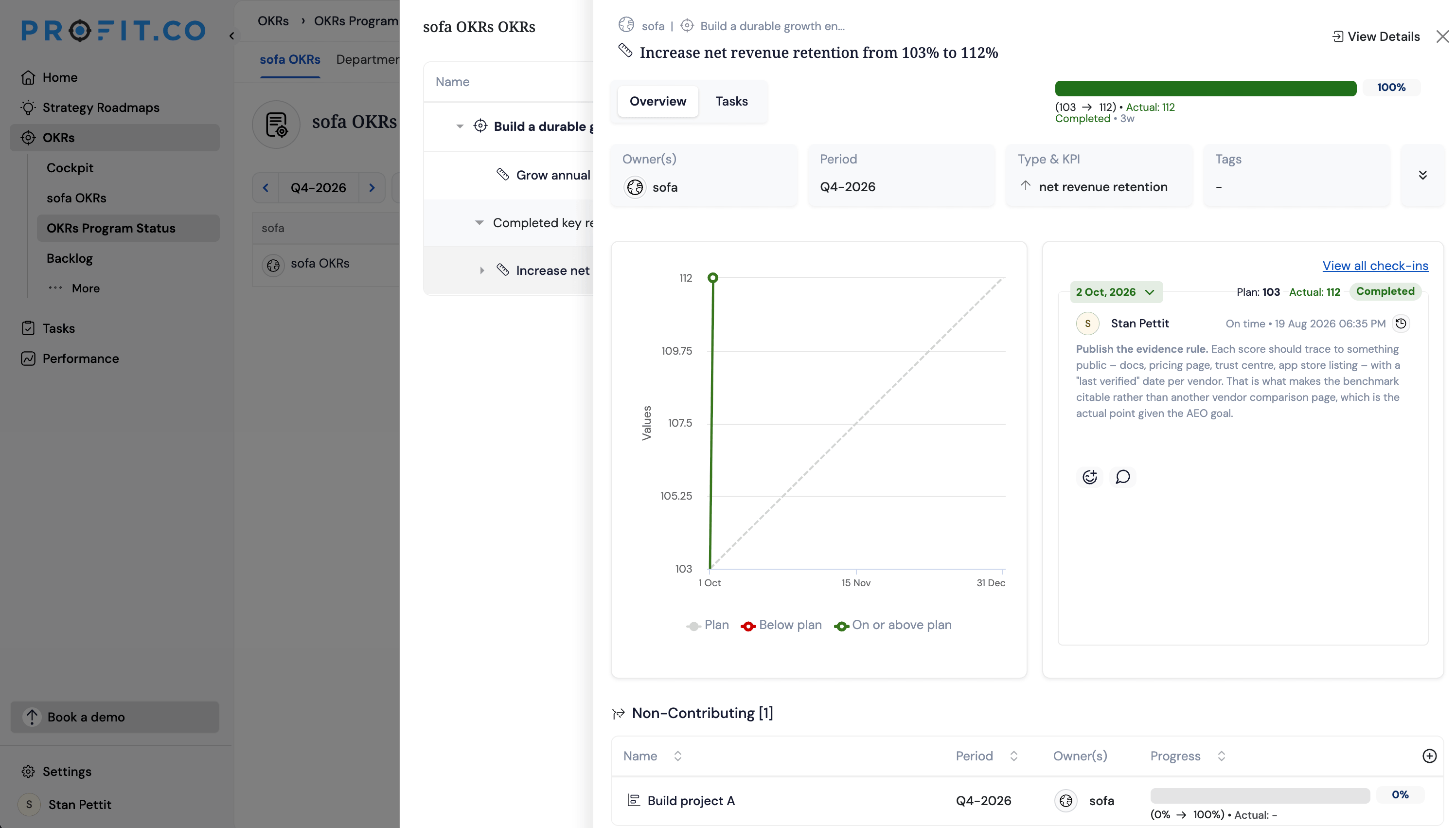
Pricing: not published. Custom quotes with a minimum annual spend around $10,000. 30-day trial.
3. 15Five
Compare 15Five to other platforms · 15five.com
Best for: companies leading with engagement and manager check-ins, where goals are part of a culture programme.
Not for: buying it only for goals.
15Five works best when goals, 1:1s and engagement surveys reinforce each other, and weighted OKRs come with the Perform plan. If you only use the goals, you pay for engagement features you don't use and get lighter goal tracking than a dedicated tool.
Pricing: Perform $11/user/month, Total Platform $16 (annual). Goals aren't included in the $4 Engage plan.
4. Leapsome
Best for: European companies that want a modular HR suite and to buy only the pieces they need.
Not for: teams that want goals without an HR platform around them.
Leapsome sells goals and OKRs as one module in a suite that also covers reviews, surveys, learning, compensation and an HRIS. The modular pricing is the appeal: you can start with goals and reviews and add the rest later. It's built to connect goals to development conversations, so the same sandbagging risk applies as with any review-linked system.
Pricing: quote-based, modular, with multi-module discounts and a one-year minimum term. 14-day trial.
5. Culture Amp
Best for: companies whose main investment is engagement surveys, with goals and reviews alongside.
Not for: anyone choosing primarily on goal tracking.
Culture Amp made its name on engagement surveys and analytics, and goal management sits in its Perform product next to reviews and 1:1s. It's a strong choice when understanding how people feel is the priority. As a goal tool, it's there to support performance conversations rather than run a quarterly execution rhythm.
Pricing: not published. Quotes depend on headcount, products and service tier, billed annually.
6. Betterworks
Compare Betterworks to other platforms · betterworks.com
Best for: enterprises of 500+ running formal goal cycles with calibration and multi-level cascading.
Not for: teams under 100, where the setup doesn't pay off.
Betterworks is one of the more mature platforms for enterprise employee goals, with AI that helps people draft goals and nudges on stalled ones. It's opinionated about how goals cascade across business units. Implementations usually involve weeks of configuration and workshops.
Pricing: quote-only.
7. Teamflect
Full benchmark profile · teamflect.com
Best for: Microsoft 365 companies that want performance reviews with light goal tracking inside Teams.
Not for: goal programmes that need to scale across many teams.
Teamflect is a performance management platform with goals included, which makes it a reasonable pick for employee goals in a Microsoft shop. The free tier is the most generous in this guide and you can hold a real conversation on a goal. The goal model itself is loose, metric types stop at three, there are no progress charts, and its AI couldn't find the goal I'd just created.
Pricing: free for up to 10 users with full functionality. Essential $7/user/month, Professional $11.
Goal setting inside your project tool
If your team already runs its work in one of these, try the built-in goals before paying for anything else. Move to a dedicated tool when goals start getting lost among the tasks, or when you need a weekly check-in rhythm separate from your sprints.
1. Asana Goals
Best for: companies already running Asana at scale that want goals linked to existing projects.
Not for: companies that aren't Asana users.
Asana Goals is the most complete goals module in this group. Goals can be set at company, team and individual level and link directly to the projects that move them. The catch is the same for every project tool: goals get updated at the cadence of tickets and lose the weight they need to drive decisions.
Pricing: goals are only on the Advanced plan ($24.99/user/month annual, $30.49 monthly) and Enterprise.
2. ClickUp Goals
Tability vs ClickUp · clickup.com
Best for: budget-conscious teams already running their work in ClickUp.
Not for: leadership teams that need goal reporting across the company.
ClickUp's goals let you group targets into folders and track them against numbers, tasks or true/false outcomes, which is enough for a team keeping its quarterly goals next to its work. It's the cheapest way to get goals if you're already paying for ClickUp. Reporting across many teams is where it runs out.
Pricing: goal tracking comes with the Unlimited plan at $7/user/month annual ($10 monthly). Business is $12.
3. monday.com
OKRs for monday.com · monday.com
Best for: teams already on monday.com that are happy to build their own OKR board.
Not for: anyone expecting a goals feature out of the box.
monday.com doesn't have a dedicated goals object. OKRs are built from boards, templates and dashboard widgets, which gives you full control of the layout and leaves check-in discipline and rollups to you. If you want a proper OKR layer on monday.com, Oboard and Tability both connect to it.
Pricing: Basic $9/seat/month, Standard $12, Pro $19 (annual). Free for 2 seats.
4. Oboard
Full benchmark profile · oboard.io
Best for: teams that live in Jira and want good check-in discussions at a very low price.
Not for: scaling across many teams, or anyone who needs SCIM.
Oboard puts OKRs inside Jira through the Atlassian Marketplace. The check-in is the highlight: a status you control, and comments built for discussion, on the cheapest platform in this guide. The default dashboard and per-team report surprised me for a tool this light. The Jira boundary is what limits it: no data connectors beyond Jira, units capped at five characters and no way to see one person's goals.
Pricing: free for 10 or fewer Jira users, then $2.16/user/month up to 100, declining with volume.
5. Atlassian Goals
Full benchmark profile · atlassian.com
Best for: free, lightweight goal visibility for teams already in Jira and Confluence.
Not for: anyone running a serious goal programme.
Free is a real argument, and Rovo found and summarised my goal correctly when several paid products couldn't. It's oddly manual for something inside Jira, though: a separate form for every measure, tickets pasted in by URL and no reporting beyond cards. See the OKR software for Jira guide if your team lives there.
Pricing: included with Atlassian Cloud plans.
Which goal setting software to pick
Team and company goals, any size: Tability first, Perdoo second. Mooncamp if you want simple and manual.
Employee goals tied to reviews: Lattice or 15Five for most companies. Leapsome if you're in Europe and want to buy modules one at a time. Culture Amp if engagement surveys are the priority. Betterworks for large enterprises with formal cycles.
Team goals and reviews in one system: Profit.co, if you have an admin to configure it.
Microsoft 365: Teamflect if performance management is in the brief, Tability if it isn't.
Already on Asana, ClickUp, monday.com or Jira: start with the built-in goals, or Oboard for Jira. Move to a dedicated tool when goals get lost among the tasks.
Free: Teamflect for 10 users, Oboard for 10 Jira users, Perdoo and OKRs Tool for 5, Weekdone for 3. Treat free plans as a trial rather than a way to run 50 people.
Cheapest at scale: OKRs Tool at $129 a month above 50 users, or Oboard for Jira teams.
AI and agents: Tability scores highest on the benchmark. Perdoo and Profit.co match it on MCP if querying goals from Claude or ChatGPT is the only requirement.
How to choose: the questions that actually matter
Forget feature checklists. Four questions will get you to the right tool faster than anything else.
1. Is this for employee performance or team goals?
These are different problems and they need different tools.
Employee performance is about individuals: how someone is doing, what they should work on next, how it ties to their review and compensation. The goal is part of a development conversation, and it lives alongside 1:1s, feedback, and calibration. Pick an HR suite: Lattice, Culture Amp, 15Five, or BetterWorks.
Team goals are about outcomes: what the business is trying to achieve this quarter, who's working on it, whether it's on track. The goal is part of an execution rhythm, and it lives alongside strategy reviews and weekly check-ins. Pick a dedicated tool: Tability, Mooncamp, Weekdone, or WorkBoard.
The common mistake is trying to do both in one tool. HR suites that bolt on team OKRs tend to make goal-setting feel like a performance review by proxy, which kills the honesty needed for ambitious goals. Dedicated goal tools that try to drive performance reviews tend to lack the calibration and comp workflows HR actually needs. Our take on performance goals vs OKRs goes deeper on why these should stay separate.
If you genuinely need both, run them in separate tools and resist the urge to merge.
2. How heavy is your existing tool stack?
Already running Asana, Monday, or ClickUp at scale? Try their goals module first. It's the cheapest path and the integration is free.
Already heavy on the Microsoft stack? Pick a platform like Tability that has Teams and Excel integrations.
Stack is light or fragmented? Pick a dedicated tool. You'll spend less time wrestling with integrations.
3. Where does your AI workflow live?
This is the question almost no comparison guide asks, and it'll matter more every quarter going forward.
If your team works primarily with Claude or ChatGPT, you want a tool with a native MCP server so your goals are queryable and updatable from those clients. Tability is the most complete here.
If your team is heavy on Microsoft Copilot, Tability and WorkBoard have the deepest integration. Goal context flows into Word, Excel, and Teams natively.
If you don't use AI agents at all yet, this question is fine to deprioritise. But be aware that goal-tracking is one of the highest-leverage places to plug agents in, and tools without a real AI story are going to feel dated very quickly.
4. What's the failure mode you're most worried about?
If your risk is "we'll set goals once and forget them," pick a tool built around a weekly check-in habit: Tability, Weekdone, or Mooncamp.
If your risk is "we'll set goals but nobody will know how they ladder up to strategy," pick a tool with strong cascading and alignment views: Tability, BetterWorks or WorkBoard.
If your risk is "we'll have goals but no way to tie them to performance conversations," pick an HR suite: Lattice, Culture Amp, 15Five.
If your risk is "we'll set goals and then waste hours every week manually updating them," pick a tool with strong AI agent support that can pull progress data automatically: Tability or WorkBoard.
The wrong tool isn't the one with fewer features. It's the one built for a different failure mode than yours.
Frequently asked questions
What is the best goal setting software for teams?
For team and company goals, Tability ranks first on The OKR Software Benchmark, ahead of Perdoo and Profit.co. For employee goals tied to reviews, an HR suite like Lattice or 15Five is the better fit.
What's the difference between goal management software and OKR software?
OKR software is a subset of goal management software. OKR tools support objectives and key results specifically, with measurable key results, confidence and quarterly cycles. Goal management software is the broader category and includes SMART goals, KPIs and other formats. If you've committed to OKRs, the best OKR software guide is the more focused read.
What is employee goal setting software?
Software for setting and tracking individual goals as part of performance management, usually alongside reviews, 1:1s and feedback. Lattice, 15Five, Leapsome, Culture Amp, Betterworks and Teamflect all fit here. It solves a different problem from team goal software, and most companies do better keeping the two separate.
What are the best free goal setting apps?
For teams, Teamflect is the most generous at 10 users with full functionality, and Oboard is free for Jira instances of 10 users or fewer. Perdoo and OKRs Tool are free for 5 users, Weekdone for 3, and Atlassian Goals is included with Atlassian Cloud. For personal goals, a dedicated habit or goal tracker app is a better fit than any of these.
How much does goal management software cost?
Dedicated tools start between $6 and $10 per user per month. HR suites start around $8 to $11 per user per month for goals, often with an annual minimum (Lattice's is $4,000). Project tools include goals from $7 per user per month on ClickUp and $24.99 on Asana. Enterprise platforms like Workboard, Betterworks and Profit.co are quote-only, with minimums starting around $10,000 a year. Breakdowns by company size are at tability.io/compare/cost.
Do I need a dedicated tool, or can I use Asana, Notion or a spreadsheet?
Under 10 people, a spreadsheet or Notion is fine. If you already run Asana, ClickUp or Jira at scale, try their goals first. Once goals start getting buried under tasks, or you need a weekly check-in rhythm separate from your sprints, a dedicated tool pays for itself. See Tability vs Notion and Tability vs spreadsheets.
What's an MCP server and why does it matter for goal tracking?
MCP (Model Context Protocol) lets AI assistants like Claude and ChatGPT read from and write to other tools. With a native MCP server, you can ask "which goals are at risk this week?" and get an answer from live data. It matters for goals because the hardest part is keeping updates current, and an assistant that can read and update your goals removes most of that work.


.jpg)

.png)